Welcome to the United States Webquest
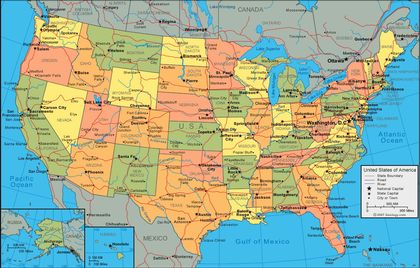
Are you ready to accept the quest?
Introduction
Congratulations! You have just been hired as the new Director of Tourism for Peinert Travel! It is your job to know EVERYTHING about all the wonderful things that your state has to offer! Every year, tourists spend millions of dollars on their vacations. People spend great amounts of time planning their vacations as well. You need to attract new tourists to your state so you can capture as much of the money that tourists spend each year.
Tourism is defined as a mixture of activities, services, and industries that delivers a vacation experience to individuals and groups traveling fifty miles or more from their homes for purposes of pleasure.
The businesses that make up the tourism industry include: transportation, accommodations, eating and drinking establishments, shops, entertainment venues, activity facilities, and a variety of hospitality service providers who cater to individuals or groups traveling away from home.
Tourism product is not produced by a single business, nonprofit organization, or governmental agency; rather, it is defined as “a satisfying visitor experience.” This definition includes every activity and experience that a tourist encounters during his or her entire trip away from home.
Essential Question: How can you persuade people to spend their vacations at all the wonderful and exciting attractions your state has to offer?
Congratulations! You have just been hired as the new Director of Tourism for Peinert Travel! It is your job to know EVERYTHING about all the wonderful things that your state has to offer! Every year, tourists spend millions of dollars on their vacations. People spend great amounts of time planning their vacations as well. You need to attract new tourists to your state so you can capture as much of the money that tourists spend each year.
Tourism is defined as a mixture of activities, services, and industries that delivers a vacation experience to individuals and groups traveling fifty miles or more from their homes for purposes of pleasure.
The businesses that make up the tourism industry include: transportation, accommodations, eating and drinking establishments, shops, entertainment venues, activity facilities, and a variety of hospitality service providers who cater to individuals or groups traveling away from home.
Tourism product is not produced by a single business, nonprofit organization, or governmental agency; rather, it is defined as “a satisfying visitor experience.” This definition includes every activity and experience that a tourist encounters during his or her entire trip away from home.
Essential Question: How can you persuade people to spend their vacations at all the wonderful and exciting attractions your state has to offer?
TASK
First, you need to select which state you are going to represent. Then you will asked to complete in-depth research to determine what your state has to offer. Then, you will create a brochure highlighting the attractions which make your state stand out from other states. Your goal is to draw as many tourists to your state as possible.

The Process
Using Microsoft PowerPoint or your Office 365, you will create a Presentation that includes the following information about your state:
* State name, motto
* Location of the state
* Major cities
* Transportation (names of major airports/train or bus stations)
* Climate and geography
* Places to stay that will attract people from different economic
backgrounds (ex: resorts AND motels)
* Four restaurants (fine dining, family friendly,
local regional cusine, fast food)
* National Parks/ Monuments/Memorials
* Family Attractions/Zoos/Amusement Parks/Water Parks etc...
* Museums/Cultural Centers
* Famous Americans from that state
* Historical Events
* Something "unique" that "can't be found anywhere else..."
You need to organize your information before you begin building your PowerPoint.
In your notebook, use the resources to gather information. You may want to create a graphic organizer or chart to keep track of your information. Use the process steps to create categories for you organizer or chart. Make sure that you write down the web addresses so that you can go back to them later.
* State name, motto
* Location of the state
* Major cities
* Transportation (names of major airports/train or bus stations)
* Climate and geography
* Places to stay that will attract people from different economic
backgrounds (ex: resorts AND motels)
* Four restaurants (fine dining, family friendly,
local regional cusine, fast food)
* National Parks/ Monuments/Memorials
* Family Attractions/Zoos/Amusement Parks/Water Parks etc...
* Museums/Cultural Centers
* Famous Americans from that state
* Historical Events
* Something "unique" that "can't be found anywhere else..."
You need to organize your information before you begin building your PowerPoint.
In your notebook, use the resources to gather information. You may want to create a graphic organizer or chart to keep track of your information. Use the process steps to create categories for you organizer or chart. Make sure that you write down the web addresses so that you can go back to them later.
Evaluation
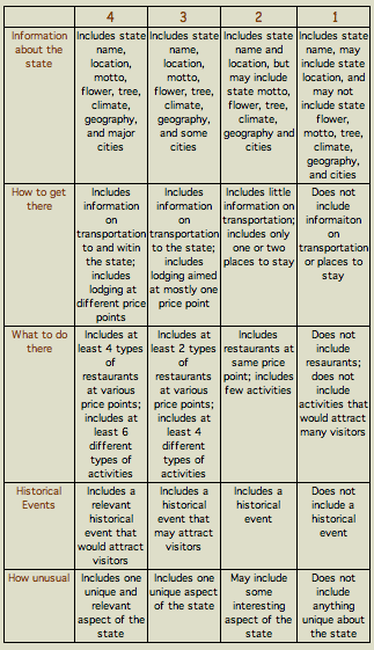
Use the following rubric to make sure that you have included all the information that you need to include! You will be assessed using this same rubric!
GREAT JOB! REMEMBER IF YOU HAVE QUESTIONS? PLEASE ASK!
